


2026 USATKD Florida State Championship
USA Taekwondo Sanctioned 12.0 Event
April 4th, 2026
IMPORTANT INFORMATION
This will be a 1-day event.
Saturday, April 4th, 2026
GENERAL INFORMATION
ALL participants (coaches and athletes) must register at: http://usataekwondo.sport80.com Registration will close Saturday, March 21st, 2026, at 23:59.
All registrations must be completed online PRIOR to the event. There will be NO onsite registrations ACCEPTED / ALLOWED.
Weigh-ins are required for all sparring competitors. Weigh-ins will be held Friday, April 3rd from 4pm to 7pm at Sarasota County Fairgrounds, Robarts Arena, 3000 Ringling Blvd., Sarasota FL 34237
Please check online at www.FlaTKD.com for official updates and notifications about this competition.
Hosted By:
Florida Sport Taekwondo Federation, Inc. (“FST”).
Tournament Director / Officials:
Master Jin Hwan Hwang, FST COO/President, Director, Tournament Director
Dr. Eric Gilson, FST Referee Chair and Tournament Referee Chairman
Master Mark Antonucci, FST CEO, Chairman,
Starry Jhoun, General Secretary
Master Dongnyeok Kang, FST Director
Master Dennis White, FST Director
General Information:
Facebook: https://www.facebook.com/FLSportTKD Website: https://FlaTKD.com/
Event Contact
Info@FlaTKD.com 1-561-231-9294
Registration Help Contact
cssimmons@usatkd.org or mnewman@usatkd.org or Call USATKD at 719-374-5745
Need help with Sport 80? Click the link below!
Competition Venue
Check-In & Weigh-In Venue
Sparring Competitors MUST check In and Weigh In the day before the Event.
Weigh-ins are required for all sparring competitors on the day before the Event. Weigh-ins will be on Friday, April 3rd, 2026, from 4pm to 8pm at the Venue.
ALL SPARRING COMPETITORS must Check/Weigh-In at registration for credential pick-up to be included in their division brackets. Check/Weigh-In’s will be held Friday, April 3rd, 2026 from 4pm to 7pm. Sparring competitors who do not weigh-in will be disqualified.
ALL POOMSAE (All), DEMONSTRATION TEAM(s) and/or BREAKING COMPETITORS do NOT need to check in, your credentials will be emailed to you, and reporting times will be posted. If Poomsae Competitors do NOT report to PRE-STAGING / Holding at their Reporting time, disqualification procedures will start to be implemented. Once Pre-Staging Holding Calls your Match or Division you will have 30 minutes to report or you will be disqualified.
POOMSAE PRE-COMPETITION REQUIREMENTS
Athletes competing in Recognized Poomsae Pairs, Recognized Poomsae Teams, and all have additional pre-competition requirements to ensure smooth competition. Pairs and Teams are required to report their team member(s) name.
Event Spectator Tickets
day pass – $20.00 Children under 5 years – FREE
Admission tickets must be Pre-Purchased prior to the Event. The tickets and wristbands will be available for pickup at the time of weigh-in/credential pickup as well as at the door during the competition.
COMPETITION REGISTRATION FEES & DEADLINES
Competitor Events
ALL participants (coaches and athletes) must register at: http://usataekwondo.sport80.com. Registration will close Saturday, March 21st, 2026, at 23:59.
U.S. National Taekwondo Championships Qualification
The 2026 Florida State Championships will qualify athletes for the U.S. National Taekwondo Championships. Athletes that finish in the Top 4 (Gold, Silver, Bronze, Bronze) at a State Championship will automatically qualify for the 2026 U.S. National Taekwondo Championships. If an athlete does not win a gold, silver, bronze, or bronze medal at a state championship the athlete can qualify for the U.S. National Taekwondo Championships through the American Open tournament series. Athletes must be a U.S. Citizen to participate in the world class divisions at the U.S. National Taekwondo Championships.
*If a State Championship has 1,300 registered athletes, then any division with 10 or more athletes that compete will qualify the top 8 finalists to the 2026 National Championships.
USA Taekwondo National Qualifying Events
| Events | Ages | Belts | |
| Sparring | All Ages | Yellow, Green, Blue, Red & Black | |
|
Recognized Sports Poomsae (Individual) |
All Ages | Yellow, Green, Blue, Red & Black | |
|
Pair Sports Poomsae (1 Male, 1 Female) |
All Ages | Black Belts | |
|
Team Sports Poomsae (3 Members Same Gender) |
All Ages | Black Belts | |
|
Free Style Poomsae (Individual) |
All Ages | Black Belts | |
|
Pair Freestyle Poomsae (1 Male, 1 Female) |
All Ages | Black Belts | |
|
Mixed Team Freestyle Poomsae (composed of 5 members, including at least 2 males and 2 females) |
All Ages | Black Belts | |
| Demonstration Team | All Ages | Yellow, Green, Blue, Red & Black | |
| Board Breaking | All Ages | Yellow, Green, Blue, Red & Black | |
USA Taekwondo Membership Requirements
Athletes must have an active USATKD membership to compete in a State Championship or Other Sanctioned Event. The membership must be active through the conclusion of the tournament. They must also have a belt listed in their USATKD profile. Please see the How To Register section of the USATKD website for step-by-step instructions.
All coaches and referees are required to hold the appropriate and current USATKD membership prior to the start of the competition and through to the completion of the event. Please see the How To Register section of the USATKD website for step-by-step instructions. If any coaches or referees participate without current USATKD membership, then the liability insurance will be invalid, and the State Association shall assume all responsibility for any injury or liabilities accrued at the event.
All coaches, referees, and club owner/instructors 18 and older are required to complete and pass the USATKD background check and complete the SafeSport training before registering for USATKD state sanctioned events.
Athletes 18 and older must complete the SafeSport training before registering for USATKD state sanctioned events.
The background check must be completed every two years. The SafeSport Refresher or Core Training must be completed every year. The background check and SafeSport must be active through the conclusion of the event.
All coaches, assistant coaches, judges and referees are required to be a member of USA Taekwondo (“USATKD”) and meet the membership requirements of each to participate in the event.
Below are links to SafeSport requirements and must be included in all tournament communications with all participants:
- HOW TO REPORT
- USATKD MAAPP POLICY
- PARENT RESOURCES
- MINOR ATHLETE SAFESPORT TRAINING
- PARENT SAFESPORT TRAINING
- SAFESPORT EDUCATION AND REPORTING
- MAAPP POLICIES
- MAAPP FOR COACHES
- SAFESPORT CODE
- SAFESPORT SANCTION LIST
- USATKD SAFESPORT STRATEGY RESPONSE AND RESOLUTION
- USATKD QUALITY AND CONTROL SYSTEM
- USATKD EDUCATION AND TRAINING POLICY
REGISTRATION
All competitors are required to have completed all the steps of Registration and register for all events they wish to participate in. The Event Registration will close on Saturday, March 21st, 2026, at 23:59. NO ONSITE Registration is ALLOWED OR ACCEPTED
*2026 USATKD Florida State Championships will not have Dragon, Tiger and Youth Pairs Poomsae, or Color belt Co-Ed Pairs.*
Registration Fees
In order to register on Sport80, make sure you choose the correct age (date of birth) and you must choose a rank (Color Belt) to let you choose a division and let you make a payment (PLEASE UPDATE YOUR PROFILE BEFORE COMPLETING YOUR REGISTRATION, THAT MEANS FROM LAST YEAR UPDATE YOU WEIGHT AND BELT).
| Registration Type | Tournament Registration | Event | Final Registration |
| Athlete | $130 | $25 | Saturday, March 21, 2026, at 23:59 |
| Coach | $65 | Saturday, March 21, 2026, at 23:59 |
Payments must be made by registration due dates. If registration is not finalized by Saturday, March 21st, 2026, at 23.59, your registration and information will not be sent to us, and your registration will not be processed. Therefore, no pending registration will be accepted after the close of registration: Saturday, March 21st, 2026, at 23:59.
Registration Checklist
Completing all items on this list will help ensure a speedy check-in and weigh-in process at the 2026 USATKD Florida State Championships.
- Ensure you registered online & input your correct weight and rank/belt. NO ON-SITE registration will be allowed.
- A valid form of ID: ID, U.S. Birth Certificate, Passport Book or Card, School ID or Report Card, Valid Driver’s License or Government Issued ID, or Military ID.
- Sparring competitors: bring appropriate attire – refer to “Weigh-In Rules.” https://www.usatkd.org/usatkd-competition-rules
- Poomsae (all) ONLY competitors must still Report-in to Pre-Staging / Holding 10 minutes prior to Report Time, if not, they may be disqualified.
- Coaches must pick up during credential pick up times only.
Weigh-in Rules
- A competitor’s weight shall be measured on the day prior to the competition. The weigh-in hours may be extended or shortened, if necessary, with prior approval by USATKD.
- A competitor’s weight may be measured only twice. If a contestant does not qualify the first time, one more official weigh-in is granted within the time limit. So as not to be disqualified during official weigh-in, scales identical to the official one shall be provided at the contestants’ place of accommodation or at the arena for pre-weigh-in.
- During the weigh-in, the contestant is required to show an ID based on the following:
- 12 years and older: Passport, Drivers License, Birth Certificate, Social Security Card, GAL, or School ID
- 11 years and younger: Passport, Birth Certificate, Social Security Card, GAL, School ID, School Report Card, or School Portal
- For contestants 17 years old and under (male and female, color belts and black belts), weigh in shall be done in athletic clothing. No midriff may be showing. Under no circumstances may a contestant under the age of 18 weigh-in in underwear, or in the nude, in the United States. There is a weigh-in allowance of 0.2 kilograms to compensate for this requirement.
- For contestants 18 years old and older, weigh-in shall be done in athletic clothing. However, if a contestant wishes, weigh-in may be done in underwear for male and underwear and bra for female contestants. Under no circumstances may a contestant weigh-in in the nude in the United States. There is a weigh-in allowance of 0.1 kilograms to compensate for this requirement.
- Any irregular action by the competitor, coach or parent during the weigh-in may result in disqualification from tournament participation.
- Random weigh-ins on the day of the competition
- At the discretion of the Events Director and Tournament Organizing Committee, random weigh -in procedures may be implemented for certain USATKD events and will be announced prior to the competition in the event’s information package.
- The random weigh-in will take place at the venue on the morning of the competition and must be completed at least 30 minutes before the start of competition each day. All competitors who pass general weigh-in must be present for random weigh-in a maximum of two (2) hours before the start of the competition; should a competitor fail to appear for the random weigh-in, he/she will be disqualified. The rate of selection for the random weigh-in (typically, 5% of all the day’s competitors) will be announced in the information package for the event.
- A maximum weight gain of 5% over the weight category is permitted. No show, or a competitor who is over the 5% limit will be disqualified. Only one weigh-in attempt will be allowed for the random weigh-in.
Explanation:
Prior to the competition: Contestants listed to compete on a scheduled day will be weighed in on the day before. The time for weigh-in will be decided by the Organizing Committee and communicated to the participants in the event information packet.
Separate weigh-in for males and females: Male and female contestants will have separate sites for weigh -ins. The gender of weigh-in officials shall be the same as that of the contestants.
Disqualification during official weigh-in: If a competitor is disqualified at the official weigh-in, the competitor will not receive a participation point. If a contestant attempts to cheat the process of weigh -in, the contestant shall be disqualified by decision of the event Referee Chairman in consultation with the weigh-in official.
Scales: The practice scale(s) must be of the same type and calibration as that of the official scale and this must be verified prior to the competition by the Organizing Committee.
No onsite registration for athletes or coaches are ALLOWED or ACCEPTED. This includes adding events. Any changes on site will have a minimum charge of $50 per change will be paid prior to change.
Coach Requirements
In addition to the coach’s attire and conduct requirements as outlined in the rules, there will be the following requirements:
- Coach courtesy hold and match management:
- First-round we will make accommodation for coaches with multiple athletes in separate rings.
- Due to the scale and scheduling of this event, referees will be instructed to hold matches for a maximum of one minute prior to starting the match.
- Once the division brackets and match orders are set by officials, no changes will be accepted on the floor.
- Coach etiquette:
- No recording video or pictures ringside or on the competition floor.
- No phones, headsets, earbuds, etc. at ringside or on the competition floor.
- No loitering behind the ring table.
- No questions during the competition
Violations of etiquette may be penalized with a yellow card (sanction).
All coaches ARE REQUIRED to hold at minimum an Associate Coach (AC) Certification within the USA Taekwondo CIDP program, be a current member, completed the Center for SafeSport training (every year), and take and clear the USATKD background check (every 2 years). Coaches may obtain the AC certification by passing the Associate Coach Quiz. The AC Coach Quiz should be completed at least 5 business days prior to the State Championship registration deadline to allow for grading. Coaches will also be required to view the Center for SafeSport Training Video. The SafeSport video, background check and Associate Coach Certification must be completed before a coach can register for an event.
All documents regarding the State Championship or an approved Sanctioned Event must inform coaches that each coach is required to be a member of USATKD, take and clear the USATKD background check every two years, complete the SafeSport video training every year, and have, at minimum, an AC certification to participate in the event. When discussing how to obtain a USATKD CIDP AC certification, please use the following link.
http://www.teamusa.org/usa-taekwondo/v2-coaching/coach-education-program
Referee Requirements
All referees must be certified by USATKD to referee at a USATKD Sanctioned State Championship or approved Sanctioned Event. It is not required to host a USATKD Referee Seminar prior to the start of the Sanctioned Event but is encouraged. This seminar will ensure all referees participating in the event are up to date on certification and rule changes.
All Referees participating in the event must complete and pass a background check (every two years). Referees will be required to view the Center for SafeSport Training Video (every year) and must have a current USATKD membership. The SafeSport video and background check must be completed before a referee can register for an event. Referees participating at the event will need to reference the USATKD Referee handbook for certification requirements. USATKD recommends, but does not require, that referees are paid to help offset any of their costs incurred during the event.
State Associations are no longer required to host a Referee Seminar, this will be optional for all State Associations. If you wish to hold a Referee Seminar the application can be found at: https://www.teamusa.org/usa-taekwondo/v2-resources/referee-certification-request
SCHEDULE OF EVENTS
Saturday, APRIL 4TH, 2026
|
REPORT TIME |
EVENT |
| 8:00am |
Credential Pick-up – Non-Sparring competitors only Coach Credential Pick-up |
| 9:00am | Competition Begins for all Competitors |
PLEASE NOTE: A more detailed schedule will be released. Registration closes on Saturday, March 21st, 2026.
COMPETITION FORMAT INFORMATION
Competitor Awards
Medals will be awarded to one 1st, one 2nd and two 3rd place winners. The Florida State Championships will qualify athletes for the U.S. National Taekwondo Championships. Athletes who finish in the Top 4 (Gold, Silver, Bronze, Bronze) at a State Championship will automatically qualify for the 2026 U.S. National Taekwondo Championships.
Competition Area & Rules
Per USATKD regulations, the competition area is open only to the following personnel. Everyone else must watch from the designated spectator areas.
- Registered & certified coaches.
- Registered & certified referees.
- Registered athletes.
- FST State Taekwondo Association staff & volunteers
Your cooperation helps us run a smooth & professional event. Thank you for your support.
FST follows all rules endorsed by USA Taekwondo found on their website at: https://www.teamusa.org/usa-taekwondo/v2-events/competition-rules
We will be using the most current USATKD Rules as updated on the https://www.usatkd.org/usatkd-competition-rules website.
2026 USATKD Kyorugi Rules, click here to download
2025 USATKD Kyorugi Rules – Modified Head Contact, click here to download
2026 USATKD Poomsae Rules, click here to download
2026 USATKD Traditional Poomsae Rules
2026 USATKD Demonstration Team Rules, click here to download
2026 USATKD Creative Breaking Competition Rules, click here to download
2025 USA TAEKWONDO Dobok, Equipment & Hygiene Standards
2026 USA Taekwondo Weigh-In Rules
https://www.usatkd.org/usatkd-competition-rules
USA Taekwondo Equipment and Hygiene Standards, Updated January 2, 2026
Athlete Uniform
Uniform Style
- Kyorugi athletes must wear WT/USATKD approved a white V-neck uniform in good condition
- Poomsae and Breaking athletes must wear a WT/USATKD-approved Y-neck or V-neck uniform in good condition, appropriate to the contestant’s division (see below)
- Demo Team athletes must wear appropriate sport attire, such as a WT/USATKD-approved Y-neck or V-neck Taekwondo uniform of any color, or team track suit

V–Neck Collar Color
- Black belts must wear black-collared uniforms
- Color belts must wear white-collared uniforms; color belts cannot wear black-collared uniforms
- Poom rank (14 and under black belts) may wear poom uniforms with black and red collar
Belts
- Permitted belt colors are white, yellow, green, red, blue, poom (black/red), and black
- Belts with stripes are allowed
- The end of the belt must be at least 10cm or higher above the knee
Undershirt – Poomsae
- Female contestants may wear a white or black undershirt
- Male contestants may not wear an undershirt
Pants
- Black pants are allowed for all athletes in all divisions
Accessories
- Patches, embroidery, logos, team names, country names, athlete names, and stripes are permitted on the uniform
- No tape will be allowed on any part of the uniform
- Shoes may not be worn
Note: USATKD reserves the right to disallow any uniform or equipment if it is found to be unsafe, offensive or degrading.
Protective Equipment for Kyorugi
Sparring contestants shall wear the following mandatory equipment:
Trunk Protector (Hogu)
- When PSS is in use, the hogu will be provided
- When PSS trunk protectors are used, the size will be determined by the weight class of the contestants; both players must use the same size
- The correct way to tie the hogu is from top to bottom; the cotton strings must thread through all eyelets of the hogu in a criss-cross fashion
- Hogu must be tied up snugly and centered on the contestant
- The extra length of strings will be tied back into the hogu

Head Protector
- When head PSS is in use, the head protector will be provided
- World Class Cadet, Junior, and Senior Black Belts are required to wear red or blue head protectors, corresponding with the color of the chest protector
- In other divisions, red or blue is recommended; white helmets will be permitted
- Cracks or defects in the foam of the head protector will not be allowed

Forearm and Shin Protectors
- Must be made of foam, cloth or vinyl
- Any color will be allowed
- Must be worn inside the uniform
- Velcro or other fastenings must be secure so as not to come loose during competition
- Cloth or foam elbow and/or knee pads are also permitted
Groin Guard
- Mandatory for both male and female competitors
- Any color will be allowed
- Must be worn inside the uniform

Gloves
- When PSS punching is in use, PSS sensing gloves must be worn
- PSS sensing gloves will be supplied by the contestant
- Gloves may be red, blue, or white; white is preferred
- If the competitor chooses to wear red or blue gloves, they must correspond with the color of the chest protector
- Gloves must be open finger style, as shown
- Other styles of gloves or hand covers are not allowed
- World Class athletes are required to wear USATKD/WT-approved gloves
- For all other divisions, gloves are optional and must comply with the above rules

Instep Protectors
- When PSS is in use, PSS sensing socks must be worn
- PSS sensing socks will be supplied by the contestant
- When Daedo Gen 2 is in use, contestants must wear Daedo Gen 2 sensing socks, with 11 magnets
- When Daedo Gen 3 is in use, contestants must wear
Daedo Gen 3 sensing socks, with 15 magnets
Mouthguard
- Must be clear or white
- Must be at least 3mm in thickness
- Athletes without braces must wear a full upper mouthguard, covering the upper teeth at least to the first molar
- Athletes with braces must wear one of the following options:
- Option 1: Double mouth guard that covers upper and lower teeth and braces (this is considered the best protection and strongly recommended)
- Option 2: Full upper mouth guard to cover braces and a partial coverage lower mouth guard for braces, which must cover at least 6 of the lower teeth (this is allowed for athletes with significant breathing issues and considered good protection)
○ Option 3: Full upper mouth guard to cover braces and a brace shield for the lower braces (this is the minimal protection for the athlete and is the least favorable option)


Personal Requirements
Bracing
- Only soft neoprene material is permitted
- No brace with any hard substance (metal, plastic, Velcro strap, etc) is permitted
- Silicon (or other soft gel) padding around the kneecap is permitted if it is soft material, and the thickness is less than 6mm (0.25 in)
- Under no circumstances will a hard splint or cast—no matter how small—be allowed
Padding
Kyorugi
- Padding of the dorsum of the foot is only allowed if the athlete has a prior injury (e.g. bruising)
- Soft foam padding (1/8” max) or gauze (4 layers max) can be used, and must be covered with minimal plain tape
- Only 2 layers of tape are allowed on the forefoot/arch of the athlete
- Padding must not cover the toe or ankle
- After the padding is wrapped with tape, it must be still soft when pressed by finger
Taping
Taping shall be allowed for the protection of athletes, as outlined below. All taping must be done and stamped by tournament medical staff prior to competition.
Kyorugi
- White or light brown/beige colored tape is allowed
- Athletic tape or kinesiotape are allowed
- Abrasive tape with a rough surface must be covered by ~1-2 layers of athletic tape
- Up to 2 layers of thin foam underwrap is allowed, which must be covered.
- Up to 4 complete layers of taping (2mm) are allowed for any injury and
- Up to 2 complete layers (1mm) are allowed for support without injury
- No taping on the knuckles of the fist is allowed
- Any taping must be removed during the general weigh-in to ensure that there is no open wound, cut, or bleeding
Poomsae
- Only 2 layers of taping is allowed
- The only permitted way to tape ankles is as pictured

Jewelry
Kyorugi
- Contestants are not allowed to wear any kind of metallic articles or hard objects, such as rings, necklaces, watches, bracelets, earrings, etc
- All jewelry must be removed prior to inspection
Poomsae
- The only jewelry permitted are earrings, which must be flush to the ea
- No other jewelry or piercings may be worn
- Inspection may request that earrings be removed if there are safety concerns

Glasses
Kyorugi
- Eyeglasses are not permitted under any circumstances, including prescribed safety or sport eyeglasses or goggles
Poomsae
- Glasses are allowed
Nails
- All competitors shall keep their fingernails and toenails cut short and sharp edges filed
- Nail polish must be white or clear
- Kyorugi competitors shall not be permitted to weigh-in until their nails meet these requirements
Hair
Long hair should be tied back securely. Soft hair ties are permitted.

Kyorugi
- Hair must be tucked securely inside the head protector
- No hair pins, bows, hats, or other hard objects may be worn
- Wearing soft religious items on the head are allowed (e.g., hijab tucked inside the dobok), and they shall not cause harm or obstruct the opposing contestant
Poomsae
- Bobby pins and hair clips shorter than 2 inches are permitted
- Large, protruding bows are not permitted
- Alligator clips are not permitted
- No hats or other items may be worn on the head except for soft religious coverings

PSS Scoring requirements.
PSS hogus and electronic head gear will be used for 8–9-year-old Black belts, 10–11-year-old black belts, and 12 years and over all belts. Athletes will need their own PSS electronic socks. Electronic hogus and headgear, when appropriate will be provided. These are sparring competitors in divisions using Junior Safety Rules or Senior Rules where head contact is allowed.
All Color belts 11 and under and Black belts under age 8 will need to bring their own hogu and head gear. PSS / esocks are not required. These are sparring competitors in divisions with no head contact allowed.
Points From Sanctioned Events
**Participating means athletes must have officially weighed-in at the event scales (sparring) and/or participated on the competition mats in front of the event referees (poomsae) and received a place within the division.** Athletes must participate in the tournament to receive points. Sparring and Poomsae points roll over for 12 months.
SPARRING: All Belts – Dragon(6-7), Tiger(8-9), Cadet(12-14), Youth(10-11), Junior(15-17), Senior(17-32) and Ultra(33+) in yellow, green, blue, red, and black belts. An athlete may acquire a maximum amount of points from sanctioned events.
POOMSAE: All Belts – Dragon(6-7), Tiger(8-9), Youth(10-11), Cadet(12-14), Junior (15-17), Under 30 (18-30), Under 40 (31-40), Under 50 (41-50), Under 60 (51-60), Under 65 (61-65), Over 65 (66+). An athlete may acquire a maximum amount of points from sanctioned events.
To receive points an athlete must weigh in, step on the mat and complete the match.
If an athlete is disqualified during a match the opponent of the disqualified athlete will receive the points from that match if they are declared the winner. The disqualified athlete will not receive points.
Athletes will only earn points in the weight division they compete in, whether the athlete loses or wins the match. If an athlete fights and completes their match they will receive points for the last round they lost in.
Athletes must compete in the age category according to the age he/she will be as of December 31, 2026.
Miscellaneous Information
- Athletes who qualify based on age can compete in both Junior and Senior sparring divisions.
- *State Championships Winner of the Cadet Grassroots divisions will not qualify for the World Class division because the Grassroots division will use Junior Safety Rules and World Class divisions will use full head contact rules (see competition rules for full explanation of rules). Once qualified for World Class, an athlete is not eligible for Grassroots divisions.
World Class vs Grassroots
World Class and Grassroots divisions will only be offered for Cadet Sparring black belts. Cadet World Class divisions will use adult rules and Cadet Grassroots divisions will use Junior Safety Rules.
Cadet Poomsae; Junior Poomsae and Sparring; Senior Sparring and Poomsae black belts will have World Class Divisions ONLY (no Grassroots divisions).
Miscellaneous Information
▪ Athletes that qualify based on age can compete in both Junior and Senior sparring divisions. ▪ *State Championships Winner of the Cadet Grassroots divisions will not qualify for the World Class division because the Grassroots division will use Junior Safety Rules and World Class divisions will use full head contact rules (see competition rules for full explanation of rules). Once qualified for World Class, an athlete is not eligible for Grassroots divisions.
SPARRING INFORMATION
Weigh-ins are required for all sparring competitors. Weigh-ins will be held Friday, April 3rd from 4pm to 7pm (the time may be adjusted as necessary) at the venue – Sarasota County Fairgrounds, Robarts Arena, 3000 Ringling Blvd., Sarasota FL 34237.
Sparring Match Format
Best of 3 System (win by rounds) shall be followed for all matches. We will use USATKD up-to-date rules and regulations, Best 2 of 3 rounds will be criteria used for sparring.
*FST reserves the right to modify the number of rounds at their discretion.
Note: Exhibition matches will be allowed as time permits AT THE END OF ALL REGULAR COMPETITION MATCHES and with permission of both competitors’ coaches. A list of single competitors will be posted on the website after registration closes. Please see the schedule for exhibition timing.
Qualification of USATKD Contestants
Citizen or resident of the United States status
- World Class Black belt athletes MUST be U.S. citizens.
- World Class ages are Cadet 12-14, Junior 15-17, Senior 17+. Cadet Grassroot Division does not require proof of citizenship (See chart below.)
- Age limit: The age limit is based on the year, not on the date.
- Must be currently registered USATKD athlete member
- All black belt contestants must submit a copy of their Dan/Poom Certificate, current USATKD identification card, and birth certificate at the time of registration with the Tournament Organizing Committee.
- To be eligible for Senior competition, contestants must be at least 17 years old in the year the pertinent tournament is held. Contestants must be between 15-17 years old for Junior Taekwondo Championships, and 12-14 years old for Cadet Championships. (Ages for Youth Olympic Games qualification might be different depending on the decision of the IOC.)
- All contestants participating in a tournament are required to observe the Code of Conduct of USATKD and the rules of the tournament. Violators are subject to sanctions.
Medical Control
At Taekwondo events promoted or sanctioned by USATKD, any use or administration of drugs or chemical substances described in the U.S. Olympic Committee anti-doping by-laws is prohibited. International Olympic Committee doping by-laws shall be applied to Taekwondo competition in the Olympic Games and other multi-sport Games.
USATKD may carry out any doping testing deemed necessary to ascertain if a contestant has committed a breach of this rule. Any winner who refuses to undergo this testing or who proves to have committed such a breach shall be removed from the final standings, and the record shall be transferred to the contestant next in line in the competition standings.
The organizing committee shall be responsible for making arrangements to carry out medical testing.
https://www.teamusa.org/usa-taekwondo/v2-events/competition-rules
SPARRING INFORMATION
Weigh-ins are required for all sparring competitors. Weigh-ins will be held Friday, April 3rd from 4pm to 7pm (the time may be adjusted as necessary) at the venue – Sarasota County Fairgrounds, Robarts Arena, 3000 Ringling Blvd., Sarasota FL 34237.
Sparring Match Format
Best of 3 System (win by rounds) shall be followed for all matches. We will use USATKD up-to-date rules and regulations, Best 2 of 3 rounds will be criteria used for sparring.
*FST reserves the right to modify the number of rounds at its discretion.
Note: Exhibition matches will be allowed as time permits AT THE END OF ALL REGULAR COMPETITION MATCHES and with permission of both competitors’ coaches. A list of single competitors will be posted on the website after registration closes. Please see the schedule for exhibition timing.
Qualification of USATKD Contestants
Citizen or resident of the United States status
- World Class Black belt athletes MUST be U.S. citizens.
- World Class ages are Cadet 12-14, Junior 15-17, Senior 17+. Cadet Grassroot Division does not require proof of citizenship (See chart below.)
- Age limit: The age limit is based on the year, not on the date.
- Must be currently registered USATKD athlete member
- All black belt contestants must submit a copy of their Dan/Poom Certificate, current USATKD identification card, and birth certificate at the time of registration with the Tournament Organizing Committee.
- To be eligible for Senior competition, contestants must be at least 17 years old in the year the pertinent tournament is held. Contestants must be between 15-17 years old for Junior Taekwondo Championships, and 12-14 years old for Cadet Championships. (Ages for Youth Olympic Games qualification might be different depending on the decision of the IOC.)
- All contestants participating in a tournament are required to observe the Code of Conduct of USATKD and the rules of the tournament. Violators are subject to sanctions.
Medical Control
At Taekwondo events promoted or sanctioned by USATKD, any use or administration of drugs or chemical substances described in the U.S. Olympic Committee anti-doping by-laws is prohibited. International Olympic Committee doping by-laws shall be applied to Taekwondo competition in the Olympic Games and other multi-sport Games.
USATKD may carry out any doping testing deemed necessary to ascertain if a contestant has committed a breach of this rule. Any winner who refuses to undergo this testing or who proves to have committed such a breach shall be removed from the final standings, and the record shall be transferred to the contestant next in line in the competition standings.
The organizing committee shall be responsible for making arrangements to carry out medical testing.
https://www.teamusa.org/usa-taekwondo/v2-events/competition-rules
USA Taekwondo Weight Sparring Weight Categories


JUNIOR SAFETY RULES
Attacks to the head with light contact is allowed. The Referee will penalize the athlete for excessive contact. The referee can decide the winner of RSC (Referee Stop Contest) in case of a significant difference of competing ability between two athletes. FST utilizes **USATKD’s KYORUGI COMPETITION RULES & INTERPRETATION Effective January 1st, 2023

POOMSAE COMPETITION INFORMATION
RECOGNIZED SPORT POOMSAE
Qualifications of USATKD Poomsae Contestants
Residency and Citizenship: Residency and Citizenship requirements are required for all black belts competing.
Contestants must be registered USATKD athlete members.
Black Belts: All black belt contestants must submit a copy of their Dan/Poom Certificate and current USATKD identification card before the athlete can be confirmed. Birth certificates must be submitted for all events Ranked 18.0 and above before the athlete can be confirmed. If any documents are missing, they will need to be submitted at the time of registration with the Tournament Organizing Committee unless otherwise directed.
Color Belts: Contestant must be a USATKD recognized rank (1st & 2nd Geup Red Belt, 3rd & 4th Geup Blue Belt, 5th & 6th Geup Green Belt, 7th & 8th Geup Yellow Belt). Color belt contestants may only wear yellow, green, blue or red belt, according to the contestant’s Geup rank.
All contestants participating in a tournament are required to observe the USATKD Code of Conduct and the rules of the tournament. Violators are subject to sanction by the USATKD.
Poomsae Classification of Competition
For Poomsae, all color belt and 6–11-year-old Black Belt divisions have only two rounds, prelim and final. For any division with more than 9 competitors, the top 8 competitors will advance to the final round. For any division with less than 9 competitors, all competitors will advance straight to the final round. Competitors will perform one Poomsae for prelim and one Poomsae for the final round. Designated Poomsae will be released closer to the tournament date.
All the other black belt divisions (individual age 12+, pairs and teams) will do WT cut off format performing one Poomsae for prelim, one Poomsae for semi-final round and two Poomsae for the final round. Designated Poomsae will be released closer to the tournament date.
All Belt Belts aged 12 and over will compete in the Recognized Sports Poomsae format. No exceptions.
- Contestants may compete in any competition division, unless they are limited by gender or age.
- Recognized Poomsae Competition
- Men’s Individual
- Women’s Individual
- Men’s Team (3)
- Women’s Team (3)
- Pair (one male, one female)
- Freestyle Poomsae Competition
- Men’s Individual
- Women’s Individual
- Pair (one male, one female)
- Mixed Team (composed of 5 members including at least 2 males and 2 females).
- One substitute may accompany the Freestyle Poomsae team.
- Mixed Poomsae Competition (First Poomsae is Recognized, and the Second Poomsae is Freestyle)
- Men’s Individual
- Women’s Individual
- Men’s Team (3)
- Women’s Team (3)
- Pair (one male, one female)
- Mixed Team (composed of 5 members including at least 2 males and 2 females).
- One substitute may accompany the Mixed Poomsae team.
- Recognized Poomsae Competition
Divisions by Gender and Age
Recognized Poomsae Competition
- Male, female and mixed divisions shall be divided according to age as follows:
|
Division |
Dragon |
Tiger |
Youth |
Cadet |
Junior |
Under 30 |
Under 40 |
Under 50 |
Under 60 |
Under 65 |
Over 65 |
Over 70 |
|
|
Age (Years) |
6 – 7 |
8 – 9 |
10 – 11 |
12 –14 | 15 –17 | 18 –30 | 31 –40 | 41 –50 | 51 –60 | 61 –65 |
66+ |
71+ |
|
|
Individual |
Male | 1 | 1 | 1 | 1 | 1 | 1 | 1 | 1 | 1 | 1 | 1 | 1 |
| Female |
1 |
1 |
1 |
1 |
1 |
1 |
1 |
1 |
1 |
1 |
1 |
1 |
|
|
Division |
Dragon & Tiger |
Youth |
Cadet |
Junior |
Under 30 |
Under 50 |
Under 60 |
Over 60 |
|
| Age (Years) | 6 – 9 | 10 – 11 | 12 – 14 | 15 – 17 | 18 – 30 | 31-50 | 51-60 | 61+ | |
| Pair | 2 | 2 | 2 | 2 | 2 | 2 | 2 | 2 | |
|
Team |
Male | 3 | 3 | 3 | 3 | 3 | 3 | 3 | 3 |
| Female |
3 |
3 |
3 |
3 |
3 |
3 |
3 |
3 |
|
Notes: Shaded cells are official WT divisions competed at USATKD-sanctioned events.
Unshaded cells are USATKD divisions that competed in USATKD-sanctioned events.
Freestyle Poomsae Competition
- Divisions of Freestyle Poomsae Competition shall be classified as follows:
| Division | Under 11 | Under 17 | Over 17 | |
| Age (Years) | 8 – 11 years old | 12 – 17 years old | 18 years old and over | |
|
Individual |
Male | 1 | 1 | 1 |
| Female | 1 | 1 | 1 | |
| Pair | 2 | 2 | 2 | |
|
Team (Mixed) |
5 (plus 1 substitute, maximum) | 5 (plus 1 substitute, maximum) | 5 (plus 1 substitute, maximum) | |
Notes: Shaded cells are official WT divisions competed at USATKD-sanctioned events.
Unshaded cells are USATKD divisions that competed in USATKD-sanctioned events.
Mixed Poomsae Competition
- Divisions of Mixed Poomsae Competition shall be classified as follows:
| Division | Over 17 | |
| Age (Years) | 18 years old and over | |
|
Individual |
Male | 1 |
| Female | 1 | |
| Pair | 2 | |
|
Team |
Male | 3 |
| Female | 3 | |
|
Team (Mixed) |
5 (plus 1 substitute, maximum) |
|
- Age limit: The age limit is based on the year, not on the date.
COMPETITION REGISTRATION FEES & DEADLINES
For the Complete and Detailed Tournament Manual, Click Here

Traditional Poomsae Competition
- Qualifications of USATKD Traditional Poomsae Contestants.
- Contestants must be registered USATKD athlete members.
- Contestant(s) must be a USATKD recognized rank (1st & 2nd Geup Red Belt, 3rd & 4th Geup Blue Belt, 5th & 6th Geup, Green Belt, 7th & 8th Geup Yellow Belt).
- Black belts may only wear a Dan or Poom belt.
- Color belt contestants may only wear a yellow, green, blue or red belt, according to the contestant’s Geup rank.
- All contestants participating in a tournament are required to observe the USATKD Code of Conduct and the rules of the tournament. Violators are subject to sanction by USATKD.
- Athlete Protection and Gender Participation Guidelines: In accordance with directives issued by the USOPC, no person who is born as a male shall be permitted to enter any USA Taekwondo event in any category designated as “Female.” For purposes of this policy, “male” means a person belonging, at conception, to the sex that produces the small reproductive cell as set out in Executive Order 14168 (January 20, 2025).
- Uniform for Contestants
- Official Uniform for Contestants
- All contestants must wear a white Taekwondo V-neck USATKD approved uniform (dobok) or WT-approved Poomsae competition uniform in good condition, and appropriate to the contestants’ division. Black Belts must wear black-collared white uniforms or WT-approved Poomsae competition uniform. Color belts may not wear black-collared or poom-collared uniforms.
- Female contestants may wear a white or black undershirt. Male contestants may not wear an undershirt.
- All athletes may wear black pants.
- Patches, embroidery, logos, team names, country names, contestant names, and stripes are permitted on the uniform. Logos or names on the back of the uniform and patches on the chest area of the uniform are also allowed.
- Shoes may not be worn.
- No tape is allowed on any part of the uniform.
- All contestants must wear a white Taekwondo V-neck USATKD approved uniform (dobok) or WT-approved Poomsae competition uniform in good condition, and appropriate to the contestants’ division. Black Belts must wear black-collared white uniforms or WT-approved Poomsae competition uniform. Color belts may not wear black-collared or poom-collared uniforms.
- Official Uniform for Contestants
- Personal Hygiene & Accessories
- All competitors must maintain the highest standard of personal hygiene, keep their nails cut short, and groom their hair neatly. Nail polish must be white or clear.
- The only jewelry permitted are earrings, which must be flush to the ear. No other jewelry or piercings may be worn. Inspection may request earrings to be removed if there are safety concerns.
- No hats or other items may be worn on the head except for religious coverings.
- Hair Accessories
- Bobby pins and hair clips shorter than 2 inches are permitted.
- Soft hair ties are permitted.
- Large Bows are not permitted.
- Alligator clips are not permitted.
- Any violators of any part of Article 4 will be required to correct the violation within one minute or shall be subject to disqualification.
- Taping
- Any taping requires medical approval and can only be for injury.
- Medical Control
- At Taekwondo events promoted or sanctioned by USATKD, any use or administration of drugs or chemical substances described in the USOC anti-doping by-laws is prohibited.
- USATKD may carry out any medical testing deemed necessary to ascertain if a contestant has committed a breach of this rule. Any winner who refuses to undergo this testing or who proves to have committed such a breach shall be removed from the final standings, and the record shall be transferred to the contestant next in line in the competition standings.
- The organizing committee shall be responsible for making arrangements to carry out medical testing.
- Contestants may compete in any competition division, unless they are limited by gender or age.
- Traditional Poomsae Competition
- Men’s Individual
- Women’s Individual
- Traditional Poomsae Competition
- Divisions are classified by the style of Traditional Poomsae permitted.
- Kukkiwon
- Male and female divisions shall be divided according to age as follows:
|
Division |
Dragon |
Tiger |
Youth |
Cadet |
Junior |
Under 30 |
Under 40 |
Under 50 |
Over 50 |
|
|
Age (Years) |
6 – 7 |
8 – 9 |
10 – 11 |
12 – 14 |
15 – 17 |
18 – 30 |
31 – 40 |
41 – 50 |
51+ |
|
|
Individual |
Male | 1 | 1 | 1 | 1 | 1 | 1 | 1 | 1 | 1 |
| Female | 1 | 1 | 1 | 1 | 1 | 1 | 1 | 1 | 1 | |
9. The only method of competition is:
-
- Single elimination tournament format
- In the single elimination tournament, a competitor is eliminated from competition after one loss.
- Competitors are matched with opponents randomly.
- Competitors perform one form in each round selected by the competitor from the designated Poomsae list for their division.
- Competitors perform simultaneously.
- Single elimination tournament format
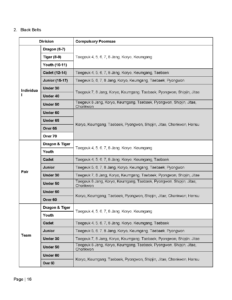
- The Compulsory Poomsae for each Traditional Poomsae division by Belt and Style.
- Prohibited Acts, The Referee shall declare penalties for any prohibited acts.
- Penalties are defined as “Kyeong-go” (deduction of points by penalties).
- “Kyeong-go” shall be declared on the following prohibited acts:
- Uttering undesirable remarks or any misconduct on the part of a contestant or a coach. This includes any act that intentionally interferes with another competitor, coach or official.
- According to the judgment of the referee, a coach, an amateur contestant or Taekwondo practitioner is not behaving with proper manner and respect the code of conduct.
- Athletes or coaches who interrupt or stand in the way of the competition coordinator while they are conducting the competition.
- Should a contestant be assessed two (2) deductions, the referee shall declare the contestant a loser on penalties. “Kyeong-go,” as defined in this Article, refers to deduction of points due to behavior that disrespects the spirit of sport, rather than due to judges’ scoring in terms of accuracy and presentation.
- When a coach or contestant commits excessive misconduct and does not follow the referee’s command, the referee may declare a sanction request by raising a yellow card. In this case, the Competition Supervisory Board shall investigate the coach’s behavior and determine whether a sanction is appropriate.
- Call for contestants
- Thirty minutes prior to the scheduled start of the contest, the names of the contestants shall be announced three times in the contestants’ pre-staging. Any contestant who fails to appear in the Competition Area after the “Chool-jeon” command of the competition coordinator shall be regarded as having withdrawn from and forfeited the match.
- Standby
- Each contestant, accompanied by only one coach, shall wait at the contestants’ waiting area for the physical and uniform inspection.
- Physical inspection and uniform inspection.
- After being called, the contestants shall undergo a physical inspection and a uniform inspection at the specified inspection desk by an inspector designated by USATKD. The contestant shall not show any signs of aversion and shall not bear any object that may cause harm to the other contestant.
- Entering the Competition Area
- Following the inspection, the contestant(s) shall enter the contestant standby waiting area with one coach. Upon the Competition Coordinator’s command of “Chool-jeon” (enter) the contestant(s) shall enter the Contest Area. When issuing the command “Chool-jeon” the Competition Coordinator motions with his/her left hand directing the contestant(s) into the Contest Area to the contestant’s designated spot. The coach remains in the designated contestant standby area.
- Single Elimination Tournament
- In individual competitions, the competitors, designated as Chung and Hong enter together.
- Contestants shall make a standing bow at the competition coordinator’s command of “Cha-ryeot” (attention) and “Kyeong-rye” (bow).
- When issuing the command “Kyeong-rye” the Competition Coordinator motions with his/her hands directing the contestant(s) to bow to the judges along Boundary Line #1.
- The Contestants perform their forms simultaneously.
- Beginning of the Performance. The performance begins when the Competition Coordinator announces “Chool-jeon,” “Cha-ryeot,” “Kyeong-rye,” “Joon-bi” and “Shi-jak” (start).
- Completion of performance
- The performance ends with the Competition Coordinator commanding “Bah-roh” (back to ready), “Shi-ah”, contestant(s) shall stand in their respective positions wait until the coordinator’s declaration of “Judges Ready” then “Pyo-chul”. Then “Cha-ryeot,” “Kyeong-rye.” When issuing the command “Kyeong-rye” the Competition Coordinator motions with his/her hands directing the contestant(s) to bow to the judges along Boundary Line #1.
- Awarding of the winner
- The Referee and Judges shall display their individual selection of a winner when the Competition Coordinator announces, “Judges Ready”, waits for the judges to be ready, followed by “Pyo-chul”. The Coordinator shall then award the winner by declaring “Chung/Hong Sung”.
- Retirement of the contestants
- The contestant exits on the Competition Coordinator’s command “Tuae-jahng” (exit). When issuing the command “Tuae-jahng” the Coordinator motions with his/her hand directing the contestant(s) from the designated spot out of the Contest Area. The hand motion shall be respectful, performed with formality, not in a dismissive fashion.
For the complete Rule Set download from USA Taekwondo, which is located on their website at: https://www.teamusa.org/usa-taekwondo/v2-events/competition-rules
DEMONSTRATION TEAM INFORMATION
Overview & General Guidelines
Demonstration Team Competition is a performance highlighting the many aspects of the art of Taekwondo, such as poomsae, breaking, acrobatic kicks, and self-defense techniques, with the addition of music and choreography.
- The performance must be confined to the 12m x 12m Contest Area. There will be a 0.1 Procedural Deduction each time a contestant crosses the boundary line with two feet during the performance. Any performance outside of the boundary line will not be scored.
- All contestants must wear appropriate sport attire, such as V-neck Taekwondo uniform of any color, WT Poomsae Competition Uniform or team track suit.
- The maximum set-up time is 1 minute.
- The maximum time to complete the performance is 6 minutes.
- The maximum clean-up time is 1 minute.
- All music must be submitted for approval prior to the competition.
- The tournament committee shall set the deadline for submissions.
- The deadline shall be a minimum of 1 week before the start of the event.
- The machine to play music shall be provided by the Tournament Committee.
- There will be no chairs or tables, and no use of tumbling boards or any similar devices.
- Use of poles and similar devices to hold boards for high jumping breaks is permitted.
- These must be approved in advance for safety.
- No Cinder Blocks or Bricks may be used for any purpose.
- Due to safety and liability issues, absolutely no weapons (i.e. swords, staves, fans, etc.), pyrotechnics, fireworks or flame breaks.
- Any Taekwondo striking or kicking technique may be used, apart from head strikes which are prohibited.
- Performing a head strike will result in a 0.3 Procedural Deduction per attempt per board.
- Performing a head strike will result in the Referee calling the medic for an examination of the athlete after the cleanup time is complete, or during the performance if there is a clear injury.
- All props used in the performance will be provided by the Demonstration Team, except for boards.
- Boards must be purchased from USATKD or a USATKD designated vendor at the competition venue.
- Competitors are cautioned to stage the performance so that flying boards do not endanger officials, spectators or other competitors.
- There will be no limit on the number of Team members. Teams are allowed 1 alternate team member to replace an injured athlete.
For the complete Rule Set download from USA Taekwondo, which is located on their website at: https://www.teamusa.org/usa-taekwondo/v2-events/competition-rules
CREATIVE BREAKING COMPETITION INFORMATION
Overview & General Guidelines
- In Creative Breaking competition, participants use powerful, correctly executed Taekwondo hand and foot techniques to break pine boards. Competitors are expected to display technical skill and proper Taekwondo manner, as well as showmanship and creativity. 1.1. Creative Breaking Competition Overview
1.2. Competitors may choose the kind of techniques and number of boards to break, up to a maximum of 15 boards. Any Taekwondo striking or kicking technique may be used, apart from head strikes, which are a 0.3 procedural deduction each.
1.3. Competitors must provide their own board holder assistants. (Please note that board holder credentials are not a pass into the event; persons receiving this credential will need to pick it up in the designated holding area and return it to the holding area after competition).
1.4. Competitors and helpers will have three minutes to set up, perform the breaking routine and clean up all boards, broken boards and wood fragments. Exceeding the time limit will result in 0.3 procedural deduction in the final score for each 10 seconds, or fraction thereof, over the time. (Example: 12 seconds over = 0.6 procedural deduction.) If computer scoring is not used, a timer will be provided for each ring.
1.5. In the interest of safety, competitors may not use props such as chairs, trampolines, tables, etc. for aerial techniques. However, board holders may be used as “human launch pads.” No glitter, confetti, explosives or sound makers may be used. Blindfolds are permitted.
1.6. Multiple attempts of a single break are allowed, but each unbroken board will result in a 0.3 technical deduction.
1.7. A “Broken Board” is defined as one that is a) completely separated; or b) held together only by wood strands, such that if one side is held horizontal, the other side naturally drops perpendicular to the floor.
1.8. Boards that are brought into the ring but not attempted will result in a 0.3 technical deduction for each board. Note that missed boards are considered attempted, and will not result in any additional penalty, other than the deduction on the failed attempt described in Section 1.6, if a competitor chooses not to re-attempt the break.
- Example 1: Competitor A brings two boards. Completed his first break but missed his second break and decided not to re-attempt. He should receive a 0.3 deduction for the missed break and no deduction for not attempting a board. • Example 2: Competitor B brings two boards. In his first attempt, he completed the first board and missed the second board. In the second attempt, he completed the second board with a different technique. He should receive a 0.3 deduction for the missed first attempt of his first break.
- Example 3: Competitor C brings 2 boards. In his first attempt, he completed the first board and missed the second board. In the second attempt, he missed the second board with a different technique. He should receive a 0.3 deduction for the missed first attempt + 0.3 deduction for the missed second attempt = total 0.6 deduction.
- Example 4: Competitor D brings 2 boards. In his first attempt, he misses both boards and does not attempt again. He should receive a 0.3 deduction for the first board + a 0.3 deduction for the second board = total 0.6 deduction.
1.9. The performance must be confined to the 8m x 8m competition area. A competitor who crosses the boundary line with two feet will receive a 0.3 procedural point deduction for each violation. Holders may cross the boundary line or stand outside the boundary line with no penalty.
1.10. Competitors will be cautioned to stage the performance so that flying boards do not endanger officials, spectators or other competitors.
1.11. Competitors may perform as many breaking techniques as they wish, as long as they do not exceed the three-minute time limit.
1.12. Boards must be purchased from FST or the FST-designated vendor at the competition venue. Under no circumstance will competitors provide their own boards. Type and size of Boards will be set by the competition committee prior to the event. Standard board sizes are:
- 6 – 9 years old: ¼ x 10 x 12-inch Pine Board
- 10 – 14 years old: ½ x 10 x 12-inch Pine Board
- 15 – 17 years old: 1 x 10 x 12-inch Pine Board
- 18 + years old: 1 x 10 x 12-inch Pine Board
1.13. No spacers may be used, including fingers. Boards may be taped together for ease of holding in multiple board breaks.
1.14. Holders may not attempt to “help” the competitor by bending, moving, or pushing the boards; any attempt to do so will result in a 0.3 technical point deduction for each instance.
1.15. Boards may not be treated, manipulated or altered to increase the likelihood of breaking; any attempt to physically alter the boards will result in disqualification of the competitor.
1.16. No bricks, cinder blocks, or tiles may be brought into the Contest Area. Any mechanical holders used for multiple board breaks must not have sharp edges and must be approved for safety by a designated official at the ring prior to competing.
1.17. Competitors are expected to display self-control and good competition manner. A display of poor sportsmanship (profanity, etc.) may be penalized by either 0.1 or 0.3 in the Technical Execution score, depending upon severity. When a competitor commits excessive misconduct and does not follow the referee’s command, he/she may be disqualified.
For the complete Rule Set download from USA Taekwondo, which is located on their website at: https://www.teamusa.org/usa-taekwondo/v2-events/competition-rules
USA TAEKWONDO SPECTATOR CODE OF CONDUCT
At all USA Taekwondo-sanctioned events, every spectator plays a vital role in creating a safe, respectful and empowering environment for athletes. By attending, you agree to uphold the values of Taekwondo: Courtesy, Integrity, Self-Control, Perseverance, and Indomitable Spirit.
USA Taekwondo is committed to three core principles: Respect, Safety, and Fair Play. These are the foundations of every USATKD-sanctioned competition and the standard we expect from all participants and spectators.
RESPECT: USA Taekwondo encourages a passionate, highly competitive environment where spectators cheer loudly, and athletes push their limits. But that passion must always be expressed respectfully. While most of our community consistently upholds this standard, we must all remain mindful that respect is non-negotiable. We are not looking to restrict the audience’s right to express displeasure but will insist that it does not cross the line into becoming abusive towards any individual. When we cheer with respect, we elevate both the athletes and the sport.
SAFETY: Our commitment to athlete well-being extends far beyond the mat. Safety is our top priority.
USA Taekwondo has a Zero Tolerance Policy for abuse of any kind. Any action that threatens the emotional or physical safety of participants has no place in our sport. USA Taekwondo adheres to the U.S. Center for SafeSport Code, which prohibits:
- Emotional Misconduct
- Physical Misconduct
- Bullying
- Hazing
- Harassment
The U.S. Center for SafeSport and USA Taekwondo provide education, training and resources for athletes, coaches and parents.
We encourage all members to take an active role in maintaining safe environments, both in person and online, so that every competitor, especially our youngest athletes, can focus on developing their skills in a supportive atmosphere. Together, we can ensure Taekwondo remains a place where every athlete feels protected, supported and inspired to grow.
FAIR PLAY: Taekwondo is more than competition – it is a discipline rooted in fairness, respect and integrity. Referees and event staff dedicate themselves to applying rules fairly and consistently, ensuring every athlete competes on equal ground.
It is every participant’s responsibility to be familiar with and follow the rules so that competition proceeds smoothly and respectfully for all involved.
To support this, USA Taekwondo offers the following resources:
U.S. Center for SafeSport Website
U.S. Center for SafeSport Code
Report a Concern to the U.S. Center for SafeSport
USA Taekwondo Social Media Comment Policy
CODE OF CONDUCT RULES
SUPPORT THE SPIRIT OF TAEKWONDO
- Applaud effort & performance for all competitors.
- Respect all athletes, coaches, referees, staff & fans.
- Enjoy the event positively & respectfully.
RESPECT ALL COACHES, REFEREES & STAFF
- Respect that referees & officials work hard to apply complex rules fairly -occasional mistakes may happen, but respect must remain.
- Abusive, aggressive, threatening or disruptive behavior is prohibited.
- Disputes and concerns must be raised through official channels.
CHEER, DON’T JEER
- Encourage athletes – never taunt, boo, heckle or shout at competitors.
- Harassment, discrimination, and intimidation are prohibited.
- Aggressive and threatening behavior is prohibited.
HELP KEEP THE EVENT SAFE
- Do not enter restricted event areas.
- Report misconduct & inappropriate behavior to event staff.
- Fighting, violence, and unsafe conduct is prohibited.
CONSEQUENCES OF MISCONDUCT
Violations of this Spectator Code of Conduct may result in the following consequences:
- Verbal/written warnings
- Suspension or expulsion from USATKD events
- Report to U.S. Center for SafeSport
- Removal from the event (no refund)
- Referral to law enforcement
- Subject to further review under USA Taekwondo disciplinary policies
By following this Spectator Code of Conduct, every spectator helps create the respectful, safe and fair environment that allows our athletes to shine. Together, we can celebrate the true spirit of Taekwondo and ensure our events remail inspiring for everyone who attends.
HOST HOTEL
Reservation will be accepted till Friday March 20th, 2026, at our negotiated rate.
Hampton Inn Sarasota I-75 Bee Ridge
5995 Cattleridge Blvd.
Sarasota, FL 34232
941.371.1900 x3
JUNIOR SAFETY RULES
Attacks to the head with light contact is allowed. The Referee will penalize the athlete for excessive contact. The referee can decide the winner of RSC (Referee Stop Contest) in case of a significant difference of competing ability between two athletes. FST utilizes **USATKD’s KYORUGI COMPETITION RULES & INTERPRETATION Effective January 1st, 2023
POOMSAE COMPETITION INFORMATION
RECOGNIZED SPORT POOMSAE
Qualifications of USATKD Poomsae Contestants
Residency and Citizenship: Residency and Citizenship requirements are required for all black belts competing.
Contestants must be registered USATKD athlete members.
Black Belts: All black belt contestants must submit a copy of their Dan/Poom Certificate and current USATKD identification card before the athlete can be confirmed. Birth certificates must be submitted for all events Ranked 18.0 and above before the athlete can be confirmed. If any documents are missing, they will need to be submitted at the time of registration with the Tournament Organizing Committee unless otherwise directed.
Color Belts: Contestant must be a USATKD recognized rank (1st & 2nd Geup Red Belt, 3rd & 4th Geup Blue Belt, 5th & 6th Geup Green Belt, 7th & 8th Geup Yellow Belt). Color belt contestants may only wear yellow, green, blue or red belt, according to the contestant’s Geup rank.
All contestants participating in a tournament are required to observe the USATKD Code of Conduct and the rules of the tournament. Violators are subject to sanction by the USATKD.
Poomsae Classification of Competition
For Poomsae, all color belt and 6–11-year-old Black Belt divisions have only two rounds, prelim and final. For any division with more than 9 competitors, the top 8 competitors will advance to the final round. For any division with less than 9 competitors, all competitors will advance straight to the final round. Competitors will perform one Poomsae for prelim and one Poomsae for the final round. Designated Poomsae will be released closer to the tournament date.
All the other black belt divisions (individual age 12+, pairs and teams) will do WT cut off format performing one Poomsae for prelim, one Poomsae for semi-final round and two Poomsae for the final round. Designated Poomsae will be released closer to the tournament date.
All Belt Belts aged 12 and over will compete in the Recognized Sports Poomsae format. No exceptions.
- Contestants may compete in any competition division, unless they are limited by gender or age.
- Recognized Poomsae Competition
- Men’s Individual
- Women’s Individual
- Men’s Team (3)
- Women’s Team (3)
- Pair (one male, one female)
- Freestyle Poomsae Competition
- Men’s Individual
- Women’s Individual
- Pair (one male, one female)
- Mixed Team (composed of 5 members including at least 2 males and 2 females).
- One substitute may accompany the Freestyle Poomsae team.
- Mixed Poomsae Competition (First Poomsae is Recognized, and the Second Poomsae is Freestyle)
- Men’s Individual
- Women’s Individual
- Men’s Team (3)
- Women’s Team (3)
- Pair (one male, one female)
- Mixed Team (composed of 5 members including at least 2 males and 2 females).
- One substitute may accompany the Mixed Poomsae team.
- Recognized Poomsae Competition
Divisions by Gender and Age
Recognized Poomsae Competition
- Male, female and mixed divisions shall be divided according to age as follows:
|
Division |
Dragon |
Tiger |
Youth |
Cadet |
Junior |
Under 30 |
Under 40 |
Under 50 |
Under 60 |
Under 65 |
Over 65 |
Over 70 |
|
|
Age (Years) |
6 – 7 |
8 – 9 |
10 – 11 |
12 –14 | 15 –17 | 18 –30 | 31 –40 | 41 –50 | 51 –60 | 61 –65 |
66+ |
71+ |
|
|
Individual |
Male | 1 | 1 | 1 | 1 | 1 | 1 | 1 | 1 | 1 | 1 | 1 | 1 |
| Female |
1 |
1 |
1 |
1 |
1 |
1 |
1 |
1 |
1 |
1 |
1 |
1 |
|
|
Division |
Dragon & Tiger |
Youth |
Cadet |
Junior |
Under 30 |
Under 50 |
Under 60 |
Over 60 |
|
| Age (Years) | 6 – 9 | 10 – 11 | 12 – 14 | 15 – 17 | 18 – 30 | 31-50 | 51-60 | 61+ | |
| Pair | 2 | 2 | 2 | 2 | 2 | 2 | 2 | 2 | |
|
Team |
Male | 3 | 3 | 3 | 3 | 3 | 3 | 3 | 3 |
| Female |
3 |
3 |
3 |
3 |
3 |
3 |
3 |
3 |
|
Notes: Shaded cells are official WT divisions competed at USATKD sanctioned events.
Unshaded cells are USATKD divisions competed in USATKD sanctioned events.
Freestyle Poomsae Competition
- Divisions of Freestyle Poomsae Competition shall be classified as follows
| Division | Under 11 | Under 17 | Over 17 | |
| Age (Years) | 8 – 11 years old | 12 – 17 years old | 18 years old and over | |
|
Individual |
Male | 1 | 1 | 1 |
| Female | 1 | 1 | 1 | |
| Pair | 2 | 2 | 2 | |
|
Team (Mixed) |
5 (plus 1 substitute, maximum) | 5 (plus 1 substitute, maximum) | 5 (plus 1 substitute, maximum) | |
Notes: Shaded cells are official WT divisions competed at USATKD sanctioned events.
Unshaded cells are USATKD divisions competed in USATKD sanctioned events.
Mixed Poomsae Competition
- Divisions of Mixed Poomsae Competition shall be classified as follows
| Division | Over 17 | |
| Age (Years) | 18 years old and over | |
|
Individual |
Male | 1 |
| Female | 1 | |
| Pair | 2 | |
|
Team |
Male | 3 |
| Female | 3 | |
|
Team (Mixed) |
5 (plus 1 substitute, maximum) |
|
- Age limit: The age limit is based on the year, not on the date.
Traditional Poomsae Competition
- Qualifications of USATKD Traditional Poomsae Contestants.
- Contestants must be registered USATKD athlete members.
- Contestant(s) must be a USATKD recognized rank (1st & 2nd Geup Red Belt, 3rd & 4th Geup Blue Belt, 5th & 6th Geup, Green Belt, 7th & 8th Geup Yellow Belt).
- Black belts may only wear a Dan or Poom belt.
- Color belt contestants may only wear a yellow, green, blue or red belt, according to the contestant’s Geup rank.
- All contestants participating in a tournament are required to observe the USATKD Code of Conduct and the rules of the tournament. Violators are subject to sanction by USATKD.
- Athlete Protection and Gender Participation Guidelines: In accordance with directives issued by the USOPC, no person who is born as a male shall be permitted to enter any USA Taekwondo event in any category designated as “Female.” For purposes of this policy, “male” means a person belonging, at conception, to the sex that produces the small reproductive cell as set out in Executive Order 14168 (January 20, 2025).
- Uniform for Contestants
- Official Uniform for Contestants
- All contestants must wear a white Taekwondo V-neck USATKD approved uniform (dobok) or WT-approved Poomsae competition uniform in good condition, and appropriate to the contestants’ division. Black Belts must wear black-collared white uniforms or WT-approved Poomsae competition uniform. Color belts may not wear black-collared or poom-collared uniforms.
- Female contestants may wear a white or black undershirt. Male contestants may not wear an undershirt.
- All athletes may wear black pants.
- Patches, embroidery, logos, team names, country names, contestant names, and stripes are permitted on the uniform. Logos or names on the back of the uniform and patches on the chest area of the uniform are also allowed.
- Shoes may not be worn.
- No tape is allowed on any part of the uniform.
- All contestants must wear a white Taekwondo V-neck USATKD approved uniform (dobok) or WT-approved Poomsae competition uniform in good condition, and appropriate to the contestants’ division. Black Belts must wear black-collared white uniforms or WT-approved Poomsae competition uniform. Color belts may not wear black-collared or poom-collared uniforms.
- Official Uniform for Contestants
- Personal Hygiene & Accessories
- All competitors must maintain the highest standard of personal hygiene, keep their nails cut short, and groom their hair neatly. Nail polish must be white or clear.
- The only jewelry permitted are earrings, which must be flush to the ear. No other jewelry or piercings may be worn. Inspection may request earrings to be removed if there are safety concerns.
- No hats or other items may be worn on the head except for religious coverings.
- Hair Accessories
- Bobby pins and hair clips shorter than 2 inches are permitted.
- Soft hair ties are permitted.
- Large Bows are not permitted.
- Alligator clips are not permitted.
- Any violators of any part of Article 4 will be required to correct the violation within one minute or shall be subject to disqualification.
- Taping
- Any taping requires medical approval and can only be for injury.
- Medical Control
- At Taekwondo events promoted or sanctioned by USATKD, any use or administration of drugs or chemical substances described in the USOC anti-doping by-laws is prohibited.
- USATKD may carry out any medical testing deemed necessary to ascertain if a contestant has committed a breach of this rule. Any winner who refuses to undergo this testing or who proves to have committed such a breach shall be removed from the final standings, and the record shall be transferred to the contestant next in line in the competition standings.
- The organizing committee shall be responsible for making arrangements to carry out medical testing.
- Contestants may compete in any competition division, unless they are limited by gender or age.
- Traditional Poomsae Competition
- Men’s Individual
- Women’s Individual
- Traditional Poomsae Competition
- Divisions are classified by the style of Traditional Poomsae permitted.
- Kukkiwon
- Male and female divisions shall be divided according to age as follows
|
Division |
Dragon |
Tiger |
Youth |
Cadet |
Junior |
Under 30 |
Under 40 |
Under 50 |
Over 50 |
|
|
Age (Years) |
6 – 7 |
8 – 9 |
10 – 11 |
12 – 14 |
15 – 17 |
18 – 30 |
31 – 40 |
41 – 50 |
51+ |
|
|
Individual |
Male | 1 | 1 | 1 | 1 | 1 | 1 | 1 | 1 | 1 |
| Female | 1 | 1 | 1 | 1 | 1 | 1 | 1 | 1 | 1 | |
- The only method of competition is:
- Single elimination tournament format
- In the single elimination tournament, a competitor is eliminated from competition after one loss.
- Competitors are matched with opponents randomly.
- Competitors perform one form in each round selected by the competitor from the designated Poomsae list for their division.
- Competitors perform simultaneously.
- Single elimination tournament format
- The Compulsory Poomsae for each Traditional Poomsae division by Belt and Style.
|
Division |
Age |
Kukkiwon |
|
Yellow (7th & 8th Geup) |
All ages |
Taegeuk 1, 2 Jang Palgwe 1, 2 Jang |
|
Green (5th & 6th Geup) |
All ages |
Taegeuk 3, 4 Jang Palgwe 3, 4 Jang |
|
Blue (3rd & 4th Geup) |
All ages |
Taegeuk 5, 6 Jang Palgwe 5, 6 Jang |
|
Red (1st & 2nd Geup) |
All ages |
Taegeuk 7, 8 Jang Palgwe 7, 8 Jang |
|
1st Dan/Poom |
All ages |
Koryo |
|
2nd Dan/Poom |
All ages |
Keumgang |
|
3rd Dan/Poom |
All ages |
Taebaek |
|
4th Dan/Poom & Up All Ages |
Dragon Tiger Youth Cadet Junior |
Pyongwon |
|
Under 30 |
Pyongwon Shipjin Jitae | |
|
Under 40 |
Pyongwon Shipjin Jitae Chonkwon | |
|
Under 50 Over 50 |
Pyongwon Shipjin Jitae Chonkwon Hansu |
- Prohibited Acts, The Referee shall declare penalties for any prohibited acts.
- Penalties are defined as “Kyeong-go” (deduction of points by penalties).
- “Kyeong-go” shall be declared on the following prohibited acts:
- Uttering undesirable remarks or any misconduct on the part of a contestant or a coach. This includes any act that intentionally interferes with another competitor, coach or official.
- According to the judgment of the referee, a coach, an amateur contestant or Taekwondo practitioner is not behaving with proper manner and respect the code of conduct.
- Athletes or coaches who interrupt or stand in the way of the competition coordinator while they are conducting the competition.
- Should a contestant be assessed two (2) deductions, the referee shall declare the contestant a loser on penalties. “Kyeong-go,” as defined in this Article, refers to deduction of points due to behavior that disrespects the spirit of sport, rather than due to judges’ scoring in terms of accuracy and presentation.
- When a coach or contestant commits excessive misconduct and does not follow the referee’s command, the referee may declare a sanction request by raising a yellow card. In this case, the Competition Supervisory Board shall investigate the coach’s behavior and determine whether a sanction is appropriate.
- Call for contestants
- Thirty minutes prior to the scheduled start of the contest, the names of the contestants shall be announced three times in the contestants’ pre-staging. Any contestant who fails to appear in the Competition Area after the “Chool-jeon” command of the competition coordinator shall be regarded as having withdrawn from and forfeited the match.
- Standby
- Each contestant, accompanied by only one coach, shall wait at the contestants’ waiting area for the physical and uniform inspection.
- Physical inspection and uniform inspection.
- After being called, the contestants shall undergo a physical inspection and a uniform inspection at
the specified inspection desk by an inspector designated by USATKD. The contestant shall not show any signs of aversion and shall not bear any object that may cause harm to the other contestant.
- Entering the Competition Area
- Following the inspection, the contestant(s) shall enter the contestant standby waiting area with one coach. Upon the Competition Coordinator’s command of “Chool-jeon” (enter) the contestant(s) shall enter the Contest Area. When issuing the command “Chool-jeon” the Competition Coordinator motions with his/her left hand directing the contestant(s) into the Contest Area to the contestant’s designated spot. The coach remains in the designated contestant standby area.
- Single Elimination Tournament
- In individual competitions, the competitors, designated as Chung and Hong enter together.
- Contestants shall make a standing bow at the competition coordinator’s command of “Cha-ryeot” (attention) and “Kyeong-rye” (bow).
- When issuing the command “Kyeong-rye” the Competition Coordinator motions with his/her hands directing the contestant(s) to bow to the judges along Boundary Line #1.
- The Contestants perform their forms simultaneously.
- Beginning of the Performance. The performance begins when the Competition Coordinator announces “Chool-jeon,” “Cha-ryeot,” “Kyeong-rye,” “Joon-bi” and “Shi-jak” (start).
- Completion of performance
- The performance ends with the Competition Coordinator commanding “Bah-roh” (back to ready), “Shi-ah”, contestant(s) shall stand in their respective positions wait until the coordinator’s declaration of “Judges Ready” then “Pyo-chul”. Then “Cha-ryeot,” “Kyeong-rye.” When issuing the command “Kyeong-rye” the Competition Coordinator motions with his/her hands directing the contestant(s) to bow to the judges along Boundary Line #1.
- Awarding of the winner
- The Referee and Judges shall display their individual selection of a winner when the Competition Coordinator announces, “Judges Ready”, waits for the judges to be ready, followed by “Pyo-chul”. The Coordinator shall then award the winner by declaring “Chung/Hong Sung”.
- Retirement of the contestants
- The contestant exits on the Competition Coordinator’s command “Tuae-jahng” (exit). When issuing the command “Tuae-jahng” the Coordinator motions with his/her hand directing the contestant(s) from the designated spot out of the Contest Area. The hand motion shall be respectful, performed with formality, not in a dismissive fashion.
For the complete Rule Set, download from USA Taekwondo, which is located on their website at: https://www.teamusa.org/usa-taekwondo/v2-events/competition-rules
DEMONSTRATION TEAM INFORMATION
Overview & General Guidelines
Demonstration Team Competition is a performance highlighting the many aspects of the art of Taekwondo, such as poomsae, breaking, acrobatic kicks, and self-defense techniques, with the addition of music and choreography.
- The performance must be confined to the 12m x 12m Contest Area. There will be a 0.1 Procedural Deduction each time a contestant crosses the boundary line with two feet during the performance. Any performance outside of the boundary line will not be scored.
- All contestants must wear appropriate sport attire, such as V-neck Taekwondo uniform of any color, WT Poomsae Competition Uniform or team track suit.
- The maximum set-up time is 1 minute.
- The maximum time to complete the performance is 6 minutes.
- The maximum clean-up time is 1 minute.
- All music must be submitted for approval prior to the competition.
- The tournament committee shall set the deadline for submissions.
- The deadline shall be a minimum of 1 week before the start of the event.
- The machine to play music shall be provided by the Tournament Committee.
- There will be no chairs or tables, and no use of tumbling boards or any similar devices.
- Use of poles and similar devices to hold boards for high jumping breaks is permitted.
- These must be approved in advance for safety.
- No Cinder Blocks or Bricks may be used for any purpose.
- Due to safety and liability issues, absolutely no weapons (i.e. swords, staves, fans, etc.), pyrotechnics, fireworks or flame breaks.
- Any Taekwondo striking or kicking technique may be used, apart from head strikes which are prohibited.
- Performing a head strike will result in a 0.3 Procedural Deduction per attempt per board.
- Performing a head strike will result in the Referee calling the medic for an examination of the athlete after the cleanup time is complete, or during the performance if there is a clear injury.
- All props used in the performance will be provided by the Demonstration Team, except for boards.
- Boards must be purchased from USATKD or a USATKD designated vendor at the competition venue.
- Competitors are cautioned to stage the performance so that flying boards do not endanger officials, spectators or other competitors.
- There will be no limit on the number of Team members. Teams are allowed 1 alternate team member to replace an injured athlete.
For the complete Rule Set download from USA Taekwondo, which is located on their website at: https://www.teamusa.org/usa-taekwondo/v2-events/competition-rules
CREATIVE BREAKING COMPETITION INFORMATION
Overview & General Guidelines
- In Creative Breaking competition, participants use powerful, correctly executed Taekwondo hand and foot techniques to break pine boards. Competitors are expected to display technical skill and proper Taekwondo manner, as well as showmanship and creativity. 1.1. Creative Breaking Competition Overview
1.2. Competitors may choose the kind of techniques and number of boards to break, up to a maximum of 15 boards. Any Taekwondo striking or kicking technique may be used, apart from head strikes, which are a 0.3 procedural deduction each.
1.3. Competitors must provide their own board holder assistants. (Please note that board holder credentials are not a pass into the event; persons receiving this credential will need to pick it up in the designated holding area and return it to the holding area after competition).
1.4. Competitors and helpers will have three minutes to set up, perform the breaking routine and clean up all boards, broken boards and wood fragments. Exceeding the time limit will result in 0.3 procedural deduction in the final score for each 10 seconds, or fraction thereof, over the time. (Example: 12 seconds over = 0.6 procedural deduction.) If computer scoring is not used, a timer will be provided for each ring.
1.5. In the interest of safety, competitors may not use props such as chairs, trampolines, tables, etc. for aerial techniques. However, board holders may be used as “human launch pads.” No glitter, confetti, explosives or sound makers may be used. Blindfolds are permitted.
1.6. Multiple attempts of a single break are allowed, but each unbroken board will result in a 0.3 technical deduction.
1.7. A “Broken Board” is defined as one that is a) completely separated; or b) held together only by wood strands, such that if one side is held horizontal, the other side naturally drops perpendicular to the floor.
1.8. Boards that are brought into the ring but not attempted will result in a 0.3 technical deduction for each board. Note that missed boards are considered attempted, and will not result in any additional penalty, other than the deduction on the failed attempt described in Section 1.6, if a competitor chooses not to re-attempt the break.
- Example 1: Competitor A brings two boards. Completed his first break but missed his second break and decided not to re-attempt. He should receive a 0.3 deduction for the missed break and no deduction for not attempting a board. • Example 2: Competitor B brings two boards. In his first attempt, he completed the first board and missed the second board. In the second attempt, he completed the second board with a different technique. He should receive a 0.3 deduction for the missed first attempt of his first break.
- Example 3: Competitor C brings 2 boards. In his first attempt, he completed the first board and missed the second board. In the second attempt, he missed the second board with a different technique. He should receive a 0.3 deduction for the missed first attempt + 0.3 deduction for the missed second attempt = total 0.6 deduction.
- Example 4: Competitor D brings 2 boards. In his first attempt, he misses both boards and does not attempt again. He should receive a 0.3 deduction for the first board + a 0.3 deduction for the second board = total 0.6 deduction.
1.9. The performance must be confined to the 8m x 8m competition area. A competitor who crosses the boundary line with two feet will receive a 0.3 procedural point deduction for each violation. Holders may cross the boundary line or stand outside the boundary line with no penalty.
1.10. Competitors will be cautioned to stage the performance so that flying boards do not endanger officials, spectators or other competitors.
1.11. Competitors may perform as many breaking techniques as they wish, as long as they do not exceed the three-minute time limit.
1.12. Boards must be purchased from FST or the FST-designated vendor at the competition venue. Under no circumstance will competitors provide their own boards. Type and size of Boards will be set by the competition committee prior to the event. Standard board sizes are:
- 6 – 9 years old: ¼ x 10 x 12-inch Pine Board
- 10 – 14 years old: ½ x 10 x 12-inch Pine Board
- 15 – 17 years old: 1 x 10 x 12-inch Pine Board
- 18 + years old: 1 x 10 x 12-inch Pine Board
1.13. No spacers may be used, including fingers. Boards may be taped together for ease of holding in multiple board breaks.
1.14. Holders may not attempt to “help” the competitor by bending, moving, or pushing the boards; any attempt to do so will result in a 0.3 technical point deduction for each instance.
1.15. Boards may not be treated, manipulated or altered to increase the likelihood of breaking; any attempt to physically alter the boards will result in disqualification of the competitor.
1.16. No bricks, cinder blocks, or tiles may be brought into the Contest Area. Any mechanical holders used for multiple board breaks must not have sharp edges and must be approved for safety by a designated official at the ring prior to competing.
1.17. Competitors are expected to display self-control and good competition manner. A display of poor sportsmanship (profanity, etc.) may be penalized by either 0.1 or 0.3 in the Technical Execution score, depending upon severity. When a competitor commits excessive misconduct and does not follow the referee’s command, he/she may be disqualified.
For the complete Rule Set download from USA Taekwondo, which is located on their website at: https://www.teamusa.org/usa-taekwondo/v2-events/competition-rules
USA TAEKWONDO SPECTATOR CODE OF CONDUCT
At all USA Taekwondo sanctioned events, every spectator plays a vital role in creating a safe, respectful and empowering environment for athletes. By attending, you agree to uphold the values of Taekwondo: Courtesy, Integrity, Self-Control, Perseverance, and Indomitable Spirit.
USA Taekwondo is committed to three core principles: Respect, Safety, and Fair Play. These are the foundations of every USATKD sanctioned competition and the standard we expect from all participants and spectators.
RESPECT: USA Taekwondo encourages a passionate, highly competitive environment where spectators cheer loudly, and athletes push their limits. But that passion must always be expressed respectfully. While most of our community consistently upholds this standard, we must all remain mindful that respect is non-negotiable. We are not looking to restrict the audience’s right to express displeasure but will insist that it does not cross the line into becoming abusive towards any individual. When we cheer with respect, we elevate both the athletes and the sport.
SAFETY: Our commitment to athlete well-being extends far beyond the mat. Safety is our top priority.
USA Taekwondo has a Zero Tolerance Policy for abuse of any kind. Any action that threatens the emotional or physical safety of participants has no place in our sport. USA Taekwondo adheres to the U.S. Center for SafeSport Code, which prohibits:
- Emotional Misconduct
- Physical Misconduct
- Bullying
- Hazing
- Harassment
The U.S. Center for SafeSport and USA Taekwondo provide education, training and resources for athletes, coaches and parents.
We encourage all members to take an active role in maintaining safe environments, both in person and online, so that every competitor, especially our youngest athletes, can focus on developing their skills in a supportive atmosphere. Together, we can ensure Taekwondo remains a place where every athlete feels protected, supported and inspired to grow.
FAIR PLAY: Taekwondo is more than competition – it is a discipline rooted in fairness, respect and integrity. Referees and event staff dedicate themselves to applying rules fairly and consistently, ensuring every athlete competes on equal ground.
It is every participant’s responsibility to be familiar with and follow the rules so that competition proceeds smoothly and respectfully for all involved.
To support this, USA Taekwondo offers the following resources:
U.S. Center for SafeSport Website
U.S. Center for SafeSport Code
Report a Concern to the U.S. Center for SafeSport
USA Taekwondo Social Media Comment Policy
CODE OF CONDUCT RULES
SUPPORT THE SPIRIT OF TAEKWONDO
- Applaud effort & performance for all competitors.
- Respect all athletes, coaches, referees, staff & fans.
- Enjoy the event positively & respectfully.
RESPECT ALL COACHES, REFEREES & STAFF
- Respect that referees & officials work hard to apply complex rules fairly -occasional mistakes may happen, but respect must remain.
- Abusive, aggressive, threatening or disruptive behavior is prohibited.
- Disputes and concerns must be raised through official channels.
CHEER, DON’T JEER
- Encourage athletes – never taunt, boo, heckle or shout at competitors.
- Harassment, discrimination, and intimidation are prohibited.
- Aggressive and threatening behavior is prohibited.
HELP KEEP THE EVENT SAFE
- Do not enter restricted event areas.
- Report misconduct & inappropriate behavior to event staff.
- Fighting, violence, and unsafe conduct is prohibited.
CONSEQUENCES OF MISCONDUCT
Violations of this Spectator Code of Conduct may result in the following consequences:
- Verbal/written warnings
- Suspension or expulsion from USATKD events
- Report to U.S. Center for SafeSport
- Removal from the event (no refund)
- Referral to law enforcement
- Subject to further review under USA Taekwondo disciplinary policies
By following this Spectator Code of Conduct, every spectator helps create the respectful, safe and fair environment that allows our athletes to shine. Together, we can celebrate the true spirit of Taekwondo and ensure our events remail inspiring for everyone who attends.
HOST HOTEL
Reservation will be accepted till Friday March 20th, 2026, at our negotiated rate.
Hampton Inn Sarasota I-75 Bee Ridge
5995 Cattleridge Blvd.
Sarasota, FL 34232
941.371.1900 x3